
Landslide and Mudslide Safety: Warning Signs and What to Do
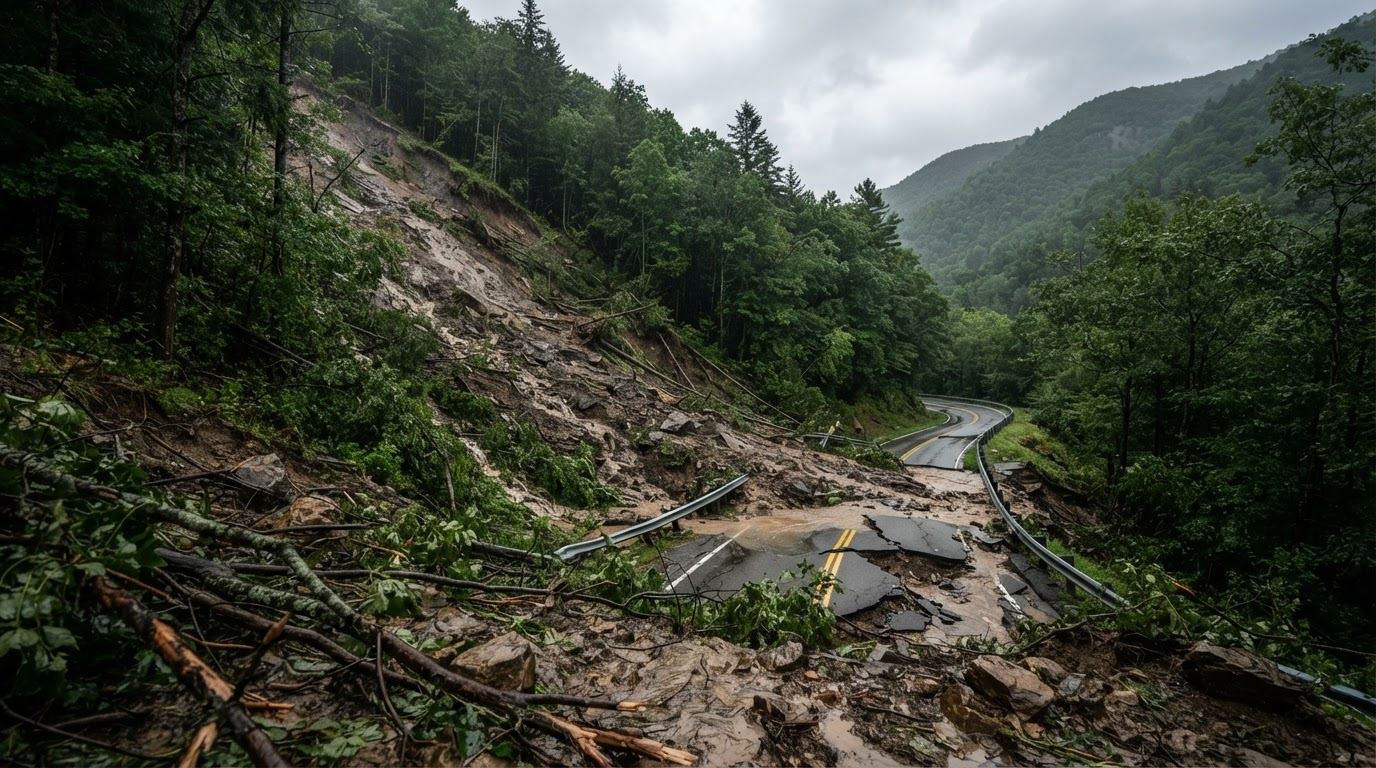
Landslides kill 25 to 50 Americans a year, often at night with no warning. Know the USGS warning signs, when to leave fast, and what to do if the slope moves.
This article contains affiliate links. If you buy through these links, we may earn a small commission at no extra cost to you.
Landslides kill an average of 25 to 50 Americans every year and cause $1 to 2 billion in damage, according to the U.S. Geological Survey, and they happen in all 50 states, not just California hillsides. The deadliest pattern is the most predictable: heavy rain on a wildfire burn scar or a long-saturated slope, often at night while people sleep. In January 2018, debris flows triggered by rain on the Thomas Fire burn scar killed 23 people in Montecito, California, per the USGS. The rules below are USGS and Ready.gov guidance: learn the warning signs, leave early, and never try to outrun a slope that is already moving.
Who Is Actually at Risk
Risk follows terrain and history. The USGS reports the greatest damage in the Appalachian, Rocky Mountain, and Pacific Coast regions plus Puerto Rico, and notes that development pushing into hillside areas puts more people in the path each year. After wildfires destroy vegetation, the USGS warns, barren ground exposed to heavy rainfall is extremely vulnerable, which puts burn-scar neighborhoods on watch for several rainy seasons. If your street was evacuated for a fire this year, read our returning-home-after-wildfire guide with the next storm in mind, not just the flames.
Local clues matter as much as maps. Oversized boulders on or below a slope mark where past debris flows came to rest, according to Ready.gov. Leaning retaining walls, patched cracks in the road above your house, and drainage converging onto one hillside spot say the same. Check the USGS hazard maps and ask the county planning office about your slope before the rainy season, because a storm is the wrong time for this research.
Warning Signs the Slope Is Moving
The USGS lists signs of both slow creep and imminent failure. Act on any one of them during heavy rain; Ready.gov puts it bluntly, by the time you are sure a debris flow is coming, it is too late to get away safely.
- Sounds. Trees cracking, boulders knocking together, or a faint rumbling that grows louder. Fast slides generate a roar and ground vibration the USGS compares to a passing freight train.
- Water behaving strangely. A stream that suddenly rises or drops while rain is still falling, or water that turns from clear to muddy. New springs, seeps, or soggy ground in places that have never been wet.
- Ground shifting. Fresh cracks or bulges in soil, pavement, or driveways. Soil pulling away from the foundation, sunken or dropped road beds, fence lines that used to run straight.
- Structures protesting. Doors or windows sticking for the first time, new cracks in plaster or foundations, walkways pulling away from the building, decks tilting relative to the house.
- Utilities breaking. Leaning poles, sagging or taut lines, broken water or sewer lines with no obvious cause. Treat tilted poles and the smell of gas as leave-now signals; our gas-leak guide covers the shutoff sequence.
If the Slope Is Moving Right Now
Leave the area immediately, but only if it is safe to do so, per the USGS. A slope can destroy a car or a house in an instant, and the first slide is often followed by more: the USGS warns landslides arrive in pulses, so the first one may not be the last.
If you are inside a building being struck, do the counterintuitive thing and stay: the USGS advises moving to the highest floor or climbing onto a countertop until the slide passes, because running out mid-slide can carry you away with it. If you are outside and caught in the path, move uphill as quickly as possible, away from the flow direction. Never cross a road with water or mud flowing across it, and never try to cross a bridge with a flow approaching it.
Drivers get their own warning because road cuts fail first. The USGS says embankments along roadsides are particularly susceptible, so watch the pavement ahead for collapsed sections, fresh mud, and fallen rocks, and treat any flooded dip with the same respect our flood safety guide demands. Report the slide to local authorities as soon as you are safe; your call may be the warning the next street gets.
The Night Storm Plan
Many debris-flow deaths happen while people sleep, according to both the USGS and Ready.gov, so a storm night on a risky slope calls for staying alert, not sleeping through it. Keep a Midland ER310 Emergency Radio weather radio in alert mode: it carries the National Weather Service flash-flood announcements that the USGS says contain the specific timing and places for debris-flow danger, and its hand-crank and solar charging keep warnings coming when the power is already out.
Stage a packed bag by the door so leaving takes seconds. A Maelstrom 40L Hiking Backpack (about $36) swallows documents, medication, and a change of clothes in one grab, and a Energizer PRO-400 Rechargeable Headlamp (about $14) keeps both hands free for stairs, debris, and the car door in a blackout. Tell one out-of-area contact your plan before the storm, the way our family communication plan lays out, so nobody drives toward you looking for you.
If the slide damaged the house but left it standing, a Tarp 12x16 ft Heavy Duty 12-mil Waterproof (about $35) covers a torn roof section or shelters salvaged gear until repairs start. Do not re-enter a damaged structure to place it; cover only what you can reach safely from outside, then photograph everything for the claim before cleanup begins.
After the Slide Passes
Stay clear of the area. The slope that just moved is the slope most likely to move again, and saturated ground above it may still be loading. Expect broken utilities, downed lines, and roads that look intact but are undermined; keep everyone, including pets, off the deposit until authorities clear it. Document damage the same way any disaster claim needs it: wide shots, close-ups, and timestamps before anything is moved, a workflow our flood-insurance documentation guide walks through even though the peril is different.
Then fix the drainage that fed it. Slopes fail where water concentrates, so the long-term work is gutters discharging away from the hillside, grading that sheds water, and ground cover that holds soil, done with a local grading contractor, not sandbags alone. The slide gave you the slope's address. Believe it.
Quick Recommendations
- Storm warnings when the power is out: Midland ER310 Emergency Radio
- One-grab evacuation bag: Maelstrom 40L Hiking Backpack
- Hands-free light for a night evacuation: Energizer PRO-400 Rechargeable Headlamp
- Cover a torn roof or salvaged gear: Tarp 12x16 ft Heavy Duty 12-mil Waterproof
One sign in heavy rain is enough to leave. The slope always tells the truth about the next storm.
Frequently asked questions
How do I know if my home is in a landslide zone?
Start with the U.S. Geological Survey landslide hazard maps and your state geological survey, then ask the county planning office about the slope above and below your lot. On the ground, oversized boulders scattered across a slope are a sign of past debris flows, according to Ready.gov. Check before you buy, not after the first rainy season.
Can a landslide happen without heavy rain?
Yes. The U.S. Geological Survey notes that strong earthquake shaking can trigger or intensify landslides, and broken water lines, construction cuts, and freeze-thaw cycles all move slopes without a storm. That said, water is the most common trigger: the USGS warns that intense short bursts of rain are especially dangerous after longer periods of heavy rainfall and damp weather.
Is it safe to drive during a landslide warning?
Driving during an intense storm is hazardous, according to the USGS: road cuts and embankments are especially susceptible, so watch for collapsed pavement, mud, and fallen rocks. Never cross a road with water or mud flowing over it, and never cross a bridge with a flow approaching, per Ready.gov, because the flow can grow faster than you can escape.
Our hill burned last summer. When are we most at risk?
The first rainy season after the fire. Burn scars shed water instead of absorbing it, which is exactly what sent deadly debris flows into Montecito, California in 2018 after the Thomas Fire. Ready.gov advises burn-area residents to sign up for emergency alerts and watch forecasts for the burn area specifically, and the USGS notes that National Weather Service flash-flood announcements carry the timing and locations for debris-flow danger.