
Keep Your Fridge Cold Without Power (2026): 4 to 72+ Hours
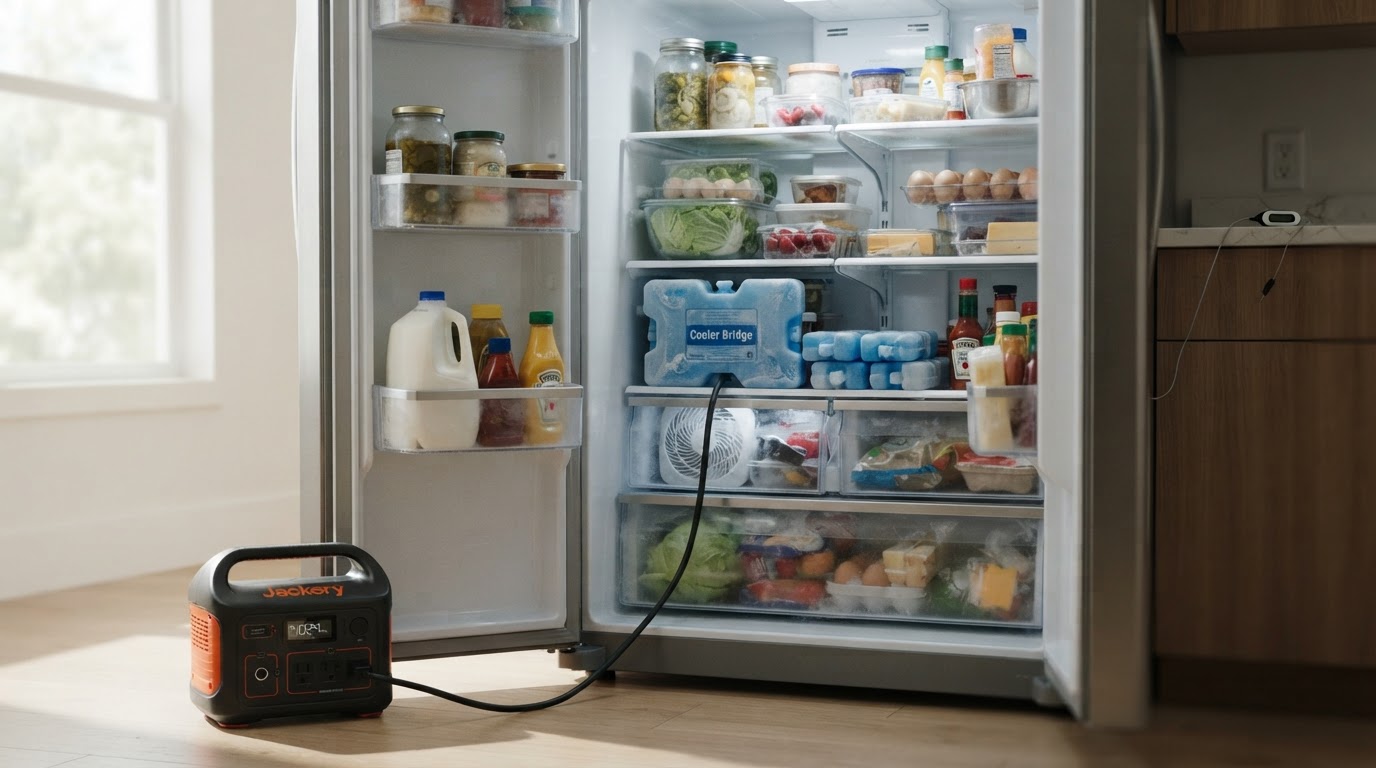
An unopened fridge stays under 40°F for just 4 hours. Compare $27 cooler bridges, 1,024Wh battery runtimes, and exact watt-hour math to save your food.
This article contains affiliate links. If you buy through these links, we may earn a small commission at no extra cost to you.
An unopened refrigerator keeps food safely below 40°F for only 4 hours after the power goes out. Past that, meat, dairy, eggs, and leftovers enter the danger zone, and a $300 grocery load becomes trash by morning. Saving it does not require a loud gas generator: a $77 thermometer-and-ice-pack bridge ($27 for the ice packs alone) buys the first 24 hours, and a 1,024Wh battery station runs a full-size fridge through the night with zero fumes.
The Clock Starts at Minute Zero: USDA Outage Windows
Opening the door "to check" dumps the cold-air reservoir and halves every window below. Leave it shut.
- Hours 0 to 4 (fridge window): an unopened refrigerator holds 40°F or below for up to 4 hours.
- Hours 4 to 24 (cooler window): at hour 4, move perishables to a pre-chilled cooler with ice packs. A half-full unopened freezer holds about 24 hours on its own.
- Hours 24 to 48 (full-freezer limit): a packed full freezer holds roughly 48 hours unopened. Door-shelf items and thin packages thaw first.
The hard rule: never taste-test for spoilage. Bacteria multiply above 40°F without changing smell or flavor. Perishables above 40°F for more than 2 hours go out.
Tier 1: The Under-$80 Bridge for 4-to-24-Hour Outages
Most outages end within a day. For those, you need temperature truth without opening the door, plus frozen mass ready before the grid drops.
- Know the exact temperature. Built-in fridge dials show settings, not degrees. The AcuRite Wireless Fridge and Freezer Thermometer… (about $50) sits inside both compartments and reads out on your counter: you see the exact minute the fridge crosses 40°F without cracking the seal.
- Keep the freezer full. A full freezer lasts twice as long as a half-full one (48 vs 24 hours) because frozen mass absorbs heat slowly. Fill dead space with frozen water jugs or Cooler Shock Reusable Ice Packs, Gray, 2 Pack (about $27 for two).
- Execute the hour-3.5 transfer. If restoration passes 4 hours, move milk, meat, eggs, soft cheese, and medications to a hard-sided cooler with the ice packs at the 3.5-hour mark. Keep the thermometer sensor in the cooler to verify 40°F or below.
- The 48-hour dry ice backup. For multi-day storms with no battery or generator, 50 pounds of dry ice holds a full 18-cubic-foot freezer about 2 extra days. Gloves always, never touching food directly, never in a sealed room.
Tier 2: Why Small Batteries Fail (and the 1,000Wh Fridge Math)
We recommend the 245Wh EcoFlow RIVER 3 Portable Power Station (about $249) for phones, routers, lights, and a mini-fridge in our best portable power stations guide. A full-size kitchen refrigerator is the classic small-battery trap. The math:
- Usable energy: a station delivers roughly 85% of its rated watt-hours as AC; the inverter and cooling eat the rest.
- Runtime formula: capacity in Wh x 0.85 / average device watts. Test your own fridge in our portable power station runtime calculator: it has a full-size fridge preset at 200W running draw. The refrigerator runtime preset answers the 1,000Wh question directly.
- Fridge draw: a modern efficient fridge pulls 150 to 300W while the compressor runs but cycles on and off, averaging about 60W over 24 hours. Older or garage fridges average 90 to 110W.
That gives 2 to 3.5 hours on a 245Wh station (assuming the startup surge does not trip its small inverter first) versus 14.5 hours on a 1,024Wh station for an efficient fridge, or 8 to 9.5 hours for an older one.
Double your runtime free: do not leave the inverter on between compressor cycles; its idle draw bleeds 10 to 15W per hour. Chill the fridge to 35°F over 90 plugged minutes, unplug and switch the AC off for 2.5 hours while the thermometer watches, repeat. Cycling stretches a 1,024Wh station from 14 hours to 24 to 30+ hours on one charge.
Tier 3: The 3 Best 1,000Wh Stations for Refrigerators (2026)
Apartments, townhomes, and HOAs where generators are banned are exactly where these earn out: 24 to 28 lbs, no fuel, no fumes, surge capacity for compressor kick. All three use LiFePO4 chemistry rated around 4,000 cycles (roughly 10 years).
- Best value: Anker SOLIX C1000 Gen 2 Portable Power Station… (about $530). 1,024Wh, 2,000W continuous (3,000W surge), 49-minute wall refill, sub-10ms UPS. The 2,000W ceiling runs the fridge plus one kitchen appliance at a time. No expansion port: 1,024Wh is the permanent ceiling.
- Best for multi-day: EcoFlow DELTA 3 Portable Power Station, 1024Wh (about $549). Same 1,024Wh class, 3,600W surge for stubborn older compressors, and the only one of the three that grows: extra batteries take it to 5,120Wh for 2-to-5-day fridge runtime. Costs about $19 more and weighs ~2.7 lbs more than the Anker.
- Best for bedrooms: Jackery Explorer 1000 v2 Portable Power Station… (about $559). 1,024Wh at ~24 lbs, the quietest fans under load, and a built-in lamp the Anker dropped. The pick if the station doubles as overnight CPAP backup. Three AC outlets and no expansion.
Top up any of them past day one with the FlexSolar 100W Foldable Solar Panel (about $100): one panel on a balcony or yard replaces several hundred watt-hours on a sunny day and keeps the compressor cycling indefinitely.
What to Buy, in Payback Order
- Step 1, every household: thermometer plus ice packs (about $77 together) and two frozen gallon jugs living in the freezer year-round.
- Step 2, overnight backup (~$530): the Anker as the core of Pack 7: Power On if a 24-hour blackout must not cost you the fridge, the CPAP, and the phones.
- Step 3, multi-day (~$96): the FlexSolar panel so day two starts with a charging battery instead of an empty one.
- Skip: 200 to 300Wh mini stations for full-size-fridge duty (night shifts, not night coverage), and any combustion generator indoors, on a balcony, or within 20 feet of a window. Storing temperature-sensitive medication has its own layering plan in our CPAP and medications guide.
Frequently asked questions
How long does a fridge stay cold without power?
An unopened refrigerator holds 40°F or below for about 4 hours. A half-full freezer lasts 24 hours unopened, a full freezer 48 hours. Perishables above 40°F for more than 2 hours must be thrown out.
Can a portable power station run a full-size refrigerator?
Yes, but only 1,000Wh-class stations. A 245Wh unit runs a full-size fridge 2 to 3.5 hours; a 1,024Wh station runs an efficient modern fridge about 14.5 hours continuous, or 24 to 30 hours with compressor cycling. The EcoFlow RIVER 3 at 245Wh is for phones and mini-fridges, not full-size kitchens.
What size battery do I need to keep food safe overnight?
A 1,024Wh LiFePO4 station (Anker SOLIX C1000 Gen 2, EcoFlow DELTA 3, or Jackery Explorer 1000 v2) covers one overnight fridge run plus phones. Expect 8 to 14.5 hours continuous depending on fridge age, stretched past 24 hours by cycling the inverter off between compressor runs.
Is dry ice safe for keeping a freezer cold?
Yes with gloves and ventilation: 50 pounds holds an 18-cubic-foot freezer about 2 extra days. Never touch it with bare hands, never let it contact food directly, and never use it in a sealed room since sublimating CO2 displaces air.