
CPAP Battery Backup and Keeping Medications Cold Without Power (2026)
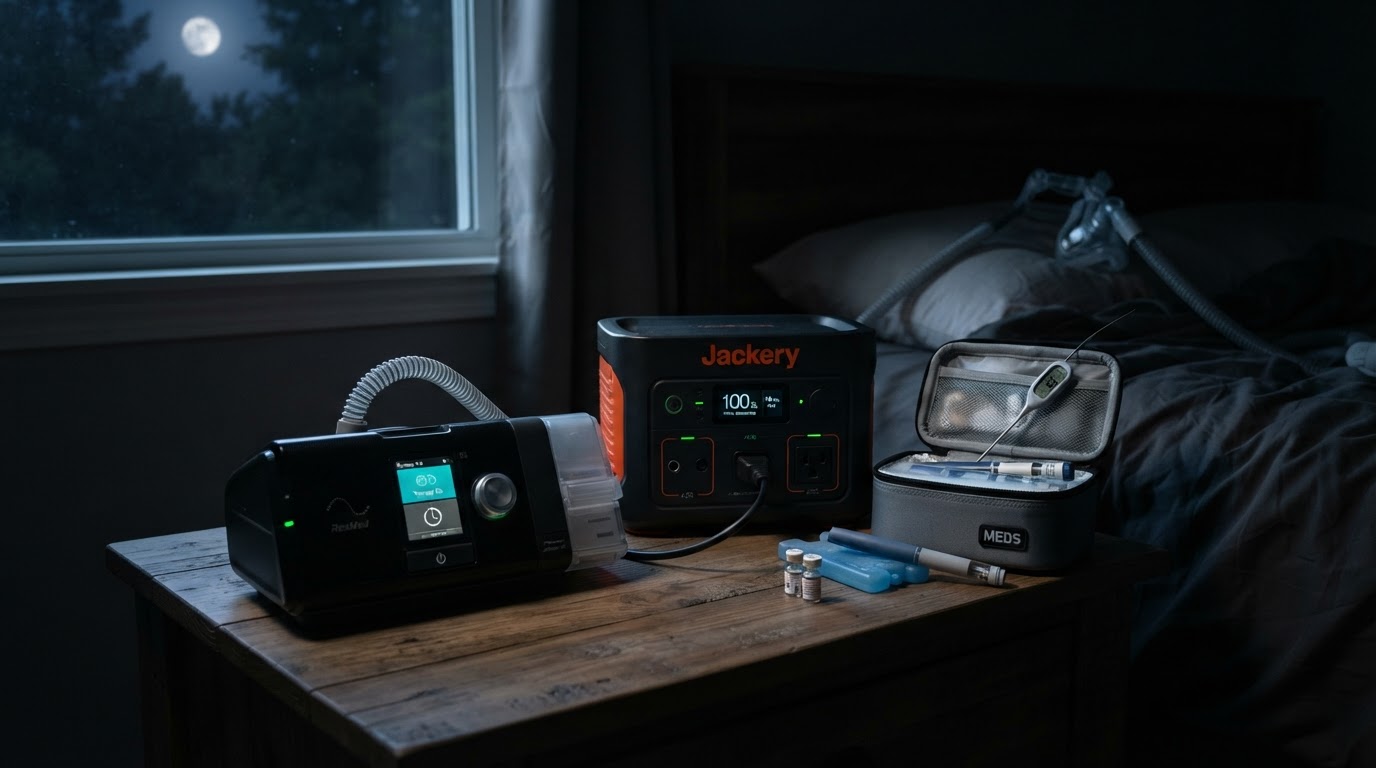
Run a CPAP through a blackout and keep insulin cold with no fridge: watt math, how many nights a power station buys, and the no-power med cooler plan.
This article contains affiliate links. If you buy through these links, we may earn a small commission at no extra cost to you.
A blackout is an inconvenience until it stops a medical device. Then it is a countdown. Two devices dominate that countdown: CPAP machines, which thousands of Americans need every night, and refrigerated medications like insulin, which spoil above 46°F. Both have solved answers: the math is simple and the gear is cheap relative to the stakes.
CPAP: The Watt Math
A CPAP without the heated humidifier draws about 30 watts. Eight hours of sleep uses roughly 240 watt-hours. Using the 85% AC inverter rule (capacity x 0.85 / watts), here is how battery size maps to nights:
- One night (~7 hours on AC, 8+ hours on 12V DC): a 245Wh station like the EcoFlow RIVER 3 Portable Power Station (about $249) delivers 208Wh of usable AC power (about 7 hours at 30W), or a full 8-hour night when plugged in via a 12V DC CPAP adapter.
- Three nights (29 hours): a 1,024Wh unit like the EcoFlow DELTA 3 Portable Power Station, 1024Wh (about $549) delivers 870Wh of usable AC power, covering 29 hours (3.5 humidifier-off nights) before needing a recharge.
- The free runtime doubler: turn off the heated humidifier and heated hose. Draw drops from ~65W to ~30W. A passover (unheated) humidifier chamber still adds comfort for near-zero watts.
Size your exact setup with our portable power station runtime calculator: it has a CPAP preset with the humidifier toggle built in. For the short version, our CPAP runtime preset page gives nights-per-charge for 245Wh vs 1,024Wh stations.
What not to do: run the machine through a cheap modified-sine inverter if you can avoid it. Most modern CPAPs tolerate it, but the efficient path is a 12V DC adapter made for your model straight into the station or car outlet: no conversion loss. And never idle the car in an attached garage for overnight power: carbon monoxide builds faster than you think, and our generator CO safety guide explains why the same rules apply to vehicles.
Refrigerated Meds: The Cold Chain Without a Fridge
Unopened insulin and GLP-1 pens need 36-46°F. Opened pens are tougher than people think: most manufacturers rate them for 28 days at room temperature below 86°F. The plan has three layers:
- First 48 hours: the cooler. Move meds to a hard cooler like the Coleman Xtreme 50QT Rolling Cooler (about $55) with frozen water bottles, not loose ice: bottles keep meltwater off labels and dosing steady. A AcuRite Wireless Fridge and Freezer Thermometer… (about $28) reads the inside temperature without opening the lid: every opening costs degrees.
- Days 3+: the FRIO wallet. The FRIO Insulin Cooling Wallet, Individual (about $29) is an evaporative case: soak it in water, wipe it dry, and crystals inside hold 36-46°F for days with zero power and zero ice. Refill with any water: tap, bottled, even stream water works since nothing touches the medication.
- Know your spoilage line. Insulin that froze (below 32°F) is ruined even after thawing: crystals break the protein. Insulin held above 86°F for extended periods loses potency silently. When in doubt, call your pharmacist before your next dose, not after.
Our elderly parents emergency plan covers the medication list, pharmacy buffer, and doctor-letter paperwork that makes this plan work under stress.
The One-Night Test
Do this before the outage: run your CPAP one night on the power station with the humidifier off, and read the remaining percentage in the morning. That number is your true runtime: labels and calculators estimate, the battery reports. Write it on tape on the station. In a blackout you will not be doing math; you will be reading tape.
Frequently asked questions
How long will a portable power station run my CPAP?
A CPAP without humidifier draws about 30 watts (240Wh over 8 hours). Factoring in the 85% AC inverter efficiency, a 245Wh EcoFlow RIVER 3 runs a CPAP for about 7 hours on AC (or a full 8-hour night using a 12V DC adapter), while a 1,024Wh station runs it for 29 hours (3.5 nights). The heated humidifier roughly doubles draw to 65W; turning it off is the single biggest runtime gain.
How do I keep insulin cold without power?
Unopened insulin needs 36-46°F. A FRIO evaporative wallet holds that range for days with just water: no ice, no power. For opened pens at room temperature, most are good for 28 days below 86°F. A cooler with ice plus a wireless fridge thermometer covers the gap between outage start and restock.
Can I run a CPAP from a car battery?
Yes with a 12V DC adapter for your machine: far more efficient than an inverter, which wastes 10-15% converting to AC and back. Never run the car in a closed garage; carbon monoxide kills faster than apnea harms.