
How to Jump Start a Car: Cable Order, Booster Packs, and Cold Weather (2026)
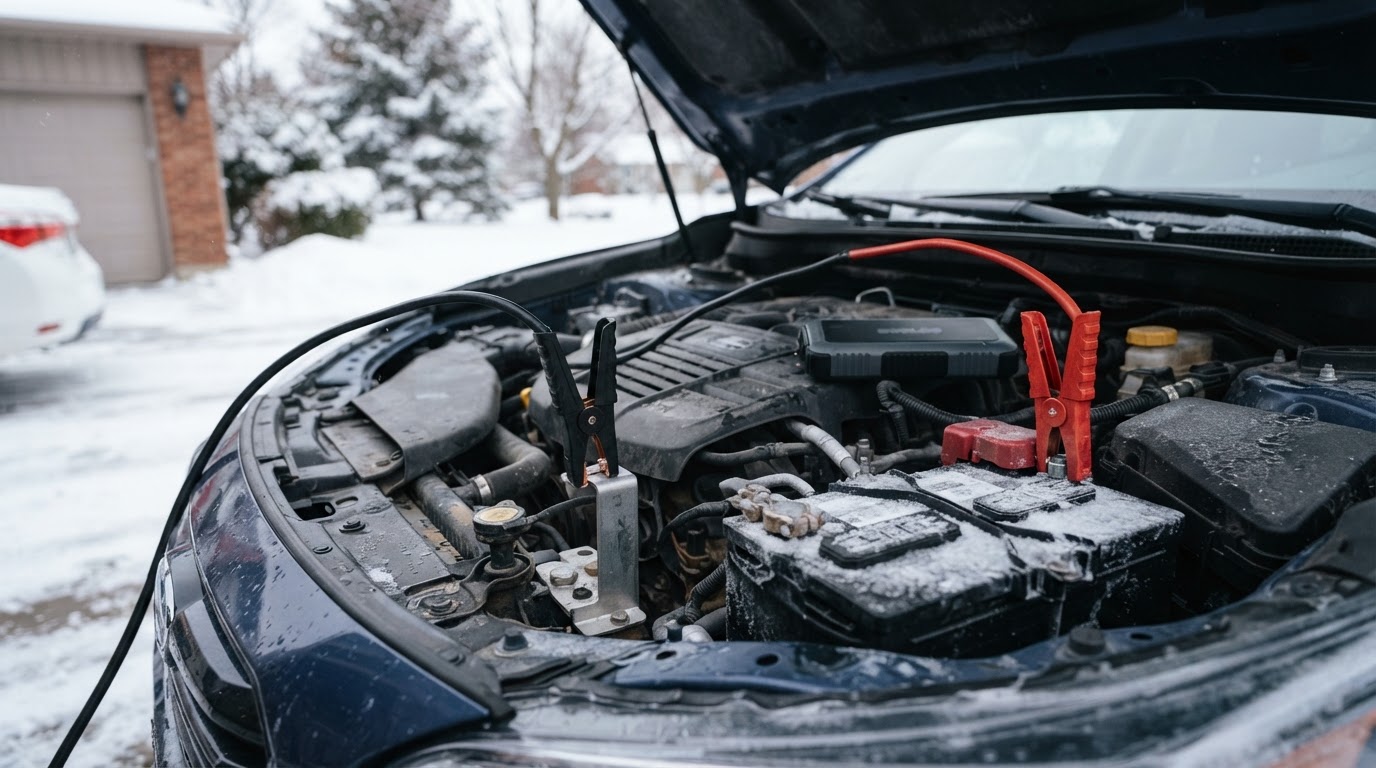
Jump start a car the right way: the exact cable order, why the last clamp goes on engine metal not the battery, booster pack steps, and when to call a tow.
This article contains affiliate links. If you buy through these links, we may earn a small commission at no extra cost to you.
A dead battery is a common cold-morning breakdown, and the fix is manageable once you know the order. Check both vehicle manuals first. Unless either manual gives a different procedure: red to the dead battery first, red to the donor battery, black to the donor's negative terminal, and the last black clamp on the dead car's designated ground point away from the battery. Start the donor, wait two or three minutes, start the dead car, and pull the clamps off in reverse order.
That last clamp is where most people go wrong. Batteries vent hydrogen gas, and the last connection is the one most likely to spark. Using the vehicle's designated ground point away from the battery keeps that spark away from the vent.
Cables or a Booster Pack: Pick Before the Morning You Need It
Jumper cables need a second car. A NOONE 2-Gauge Jumper Cables is a 20-foot, 2-gauge set at about $34. Its insulated parrot-jaw clamps and reverse-polarity warning are useful, but the clamps still need clean, solid contact. Twenty feet gives you more room when the cars cannot park nose to nose.
A NOCO Boost GB40 1000A Jump Starter is the no-donor alternative; check the live listing because Amazon had no new featured offer when we reviewed it. It is a 1000-amp lithium jump starter with spark-proof and reverse-polarity protection, and it doubles as a USB power bank. No second car is required. The pack still needs routine charging, so top it off every couple of months and after every use.
Cables make sense in a two-car driveway. A pack makes more sense for a single-car household or parking spot where a donor cannot get close. Carrying both adds redundancy, but either one works if it is maintained and within reach.
The Cable Order, Step by Step
Park the cars nose to nose, close enough that the cables reach without stretching, not touching. Both engines off. Both cars in Park or neutral with the parking brake set. Do not lean over the battery, and keep flames and sparks away from it.
- Red clamp to the dead battery's positive terminal. It is marked with a +, usually under a red cap.
- Red clamp to the donor battery's positive terminal.
- Black clamp to the donor battery's negative terminal.
- Black clamp to the designated ground point shown in the dead car's manual, away from the battery. If the manual specifies bare metal, use a solid unpainted bracket or bolt clear of belts, fans, fuel lines, and other moving parts.
Start the donor and let it idle for two or three minutes. Then start the dead car. If it cranks slowly, wait a few more minutes and try again; a deeply discharged battery needs time to take charge. Once the dead car is running, remove the clamps in the exact reverse order: black off the ground point, black off the donor, red off the donor, red off the dead battery.
Rapid clicking means the starter is not getting enough voltage. Recheck each clamp for clean, firm contact first. If the connections are sound and it still clicks after a few minutes with the donor running, the battery may be deeply discharged or failing. The winter car maintenance checklist covers the terminal-cleaning fix that prevents this in the first place.
Why Cold Mornings Kill Batteries
Cold cuts a lead-acid battery's available cranking power while thickened engine oil makes the starter work harder. A battery that was marginal in October may not start the car in January.
If your battery is four or five winters old, get it load-tested before the first hard freeze. Replace it if it fails the test or repeatedly loses charge; age is a reason to test, not an automatic verdict. Many auto-parts stores offer the test at no charge.
The Booster Pack Method
A booster pack skips the donor car entirely. Connect it straight to the dead battery, red to positive and black to negative or to a ground point, exactly as the sticker on the pack says. Start the car as soon as it is connected, and once it runs, remove the clamps almost immediately; packs are not built to carry the load any longer than that.
Two habits keep a pack honest. Charge it every couple of months and after every use; self-discharge is why packs fail the one morning they are needed. And remember it is a two-in-one: a charged NOCO Boost GB40 1000A Jump Starter is also the phone charger that keeps you reachable while you wait, which matters on a dark, cold shoulder.
When Not to Jump Start: Call a Tow Instead
If the battery case is swollen, cracked, or frozen solid, do not jump it. A frozen battery can crack or explode when current flows through it, and that repair bill dwarfs a tow. Same for a battery that is smoking, leaking, or smells strongly of rotten eggs.
Jumping also will not fix a car that starts and dies again a minute later, an engine that cranks fine but never fires, or a battery that needs a jump every other morning. Those are alternator, starter, fuel, or drain problems. Get it tested and repaired; a jump start is a bandage, not a treatment.
Hybrids and electrics run their own rules. Read both owner's manuals before connecting anything; some EVs cannot donate a jump, and some need a specific procedure on their own battery. When in doubt, the tow driver has seen your exact car before.
After It Starts
After the engine starts, follow the vehicle manual. A 20- to 30-minute drive may replace some of the lost charge, but it will not reliably refill a deeply discharged battery. Have the battery and charging system tested. If it needs a full recharge, a maintainer like the … (about $17) charges a drained 12-volt battery at 1.5 amps, then holds it at full charge. Slow is fine: it is built to stay connected, so a car that sits for weeks starts on its own.
Then restock the trunk while you are thinking about it: a set of NOONE 2-Gauge Jumper Cables, a portable charger, and the rest of the best car emergency kits checklist. If a crash left someone with a dead battery, the first steps at a crash scene guide covers the rest of that day.
A jump start is a five-minute skill with a one-move safety lesson: the last clamp goes on metal, not the battery. Learn it on a warm afternoon while the battery still works, and a cold morning becomes a slow start instead of a breakdown.
Frequently asked questions
What order do jumper cables go in?
Check both vehicle manuals first. Unless either manual gives a different procedure: red to the dead battery positive, red to the donor positive, black to the donor negative, then black to the dead car's designated ground point away from the battery. Start the donor, wait a couple of minutes, start the dead car, and remove the clamps in reverse order.
Why use a ground point away from the dead battery?
The final connection may spark. Keeping that spark away from battery vents reduces the chance of igniting hydrogen gas.
Can you jump start a frozen battery?
No. If the case is swollen or the electrolyte froze, a jump can crack or explode the battery. Call a tow and have the battery tested instead.