
How to Change a Flat Tire: The Exact Order of Operations (2026)
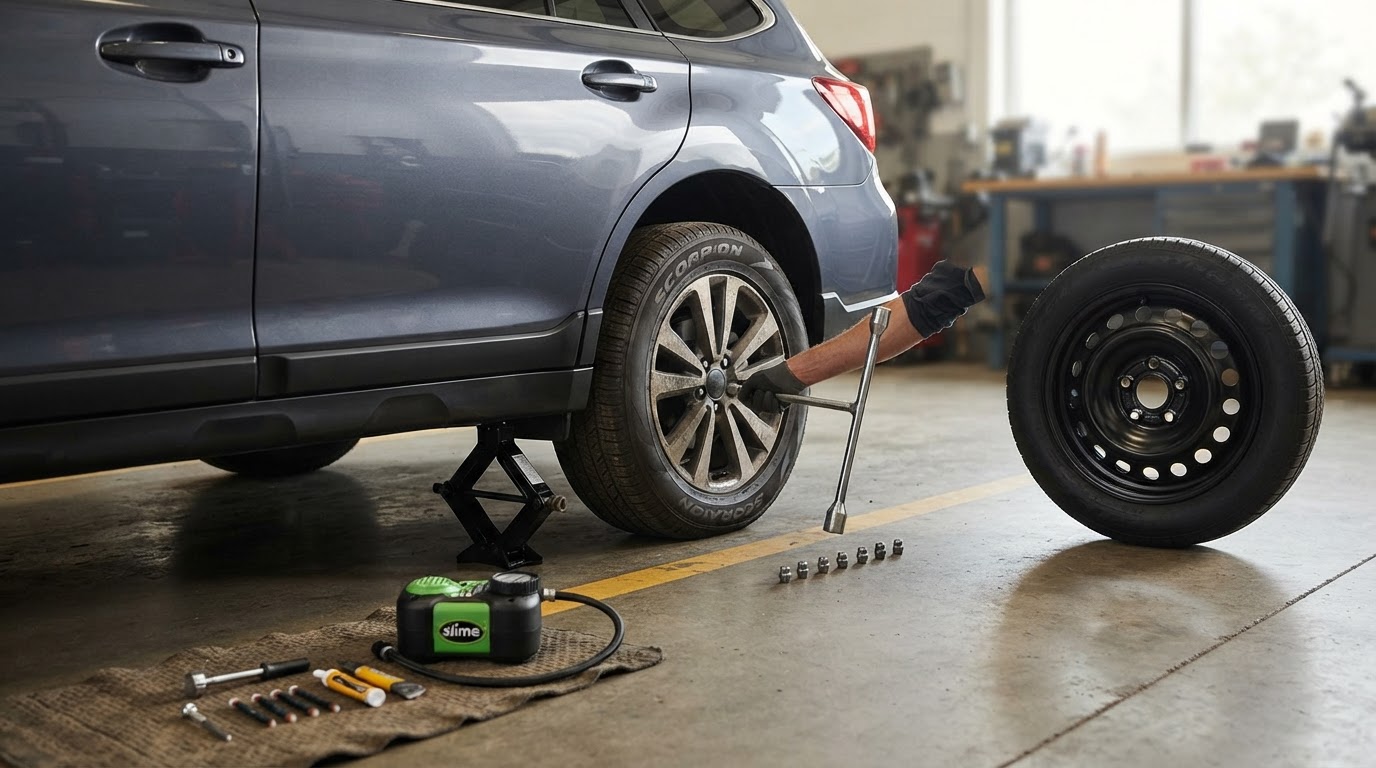
How to change a flat tire safely: where to park, when to loosen lug nuts, jack points, spare limits, and when a plug kit plus inflator beats the jack.
The short answer: change a flat in this order: park on firm, level ground with the wheels straight, set the parking brake, chock the opposite wheel, loosen the lug nuts while the car is still on the ground, jack it up, swap the tire, tighten in a star pattern, and re-torque after about 50 miles. If you cannot get a safe parking spot, skip straight to calling for help. No flat is worth changing where a car might hit you.
Spend ten minutes now, before you need it
Open the owner manual once and answer four questions:
- Does the car even have a spare? Many newer cars ship with an inflator kit and no spare. If yours does, the roadside fix is the plug-and-inflate branch below, or a tow.
- Where are the jack, the lug wrench, and the spare? Usually under the trunk floor, sometimes behind a panel.
- What kind of spare is it? A matching full-size spare can usually be driven normally, but some full-size spares are temporary. A donut always has lower speed and distance limits. Read the tire label and the owner manual before driving.
- Do you have wheel locks? The key lives in the glove box or with the jack. Find it before you need it in the dark.
While you are at it, confirm your tool layer, like the Apollo Tools DT0006 101-Piece Mechanic Tool Set socket set, has a socket that fits your lug nuts. Factory wrenches work; a socket handles a rounded nut better.
Step 1: Park somewhere safe
- Pull as far off the road as the shoulder allows, on firm, level ground. Soft dirt and gravel make a jack sink or tip.
- Aim the wheels straight, set the parking brake, and put the car in Park.
- Turn on the hazards. Get everyone out on the side away from traffic.
- Set a warning triangle a good distance behind the car, farther back on a highway, and put on a reflective vest if you have one. The HAIPHAIK Car Emergency Kit with Jumper Cables ships both.
- Chock the wheel diagonally opposite the flat, on both sides of that tire. Big rocks work if you have no chocks. A pair of solid rubber chocks like the Fasmov Solid Rubber Wheel Chocks (2 Pack) (about $17) lives in the trunk next to the jack.
If the shoulder is narrow or the road curves blind, do not change the tire here. Call roadside assistance or a tow.
Step 2: Loosen the lug nuts before the car leaves the ground
The car's weight holds the tire still.
- Turn each nut counterclockwise unless the owner manual explicitly says otherwise. If one will not move, do not guess at the thread direction.
- Loosen each nut about a half turn. Do not remove them yet.
- Stuck nut? Put the wrench nearly horizontal and press down smoothly with your body weight. Do not jump on it or add a pipe that the wrench was not designed for. If it still will not move, call roadside assistance.
Never loosen lugs with the car already on the jack. The car can rock off it and land on you.
Step 3: Jack it up
- Put the jack under the correct jack point. The manual shows them: reinforced frame notches a few inches behind or ahead of each wheel. Never jack on the plastic rocker panel.
- Seat the jack's cradle in the notch before you pump, and crank until the flat tire just clears the ground, no more.
- Once it is up, treat the jack as a lifting device only. Nothing under the car.
Step 4: Swap the tire
- Finish removing the lug nuts and set them where they cannot roll under the car.
- Pull the flat straight off the studs. If it is stuck to the hub, stop rather than kicking a car that is supported only by the factory jack. Roadside assistance is safer than knocking the car off the jack.
- Lay the flat tire on the ground clear of the work area. Keep every part of your body out from under a car supported only by the jack.
- Line the spare's holes up with the studs and push it on. If it will not seat, lift the jack a little.
- Start the lug nuts by hand, a few turns each, so the wheel is held true before any tool touches it.
Step 5: Tighten in a star pattern, then tighten again later
- Lower the jack until the spare touches the ground and carries the car's weight, then tighten the nuts firmly.
- Go in a star or crisscross pattern, top, bottom-left, top-right, bottom, top-left, two passes tighter each time. Opposite nuts, never in a circle, or the wheel seats crooked.
- Use the torque specification in the owner manual. Snug the nuts in a star pattern with the hand wrench, then tighten them to specification with a torque wrench as soon as possible. Overtightening can damage the studs or brake rotor.
- Lower the jack fully, remove it, and stow every tool. Recheck the lug-nut torque after about 50 miles if the owner manual or repair shop calls for it.
Know the spare's limits
Donut spares are for getting to a shop, not normal driving: usually 50 mph and 50 miles, and the sticker on the spare is the truth. All-wheel-drive cars can stress their drivetrain on a mismatched donut, so check the manual. Get the flat repaired or replaced within days.
When a mobility kit beats the jack
Some factory mobility kits can temporarily seal a small tread puncture without removing the wheel. Follow the owner manual and kit directions exactly. This is transportation to a repair shop, not a proper tire repair.
- Leave the nail or screw in place until you are ready to use the approved kit. If the injury is in the shoulder or sidewall, the tire is torn, or it was driven flat, use the spare or call for a tow.
- If your vehicle's kit permits it, use its sealant and compressor as directed. The EPAuto 12V Portable Air Compressor can add air, but it cannot make a damaged tire safe.
- An outside-in string plug such as the Slime 2040-A Tire Repair Plug Kit is an emergency measure only. Industry guidance calls for tire removal, an internal inspection, and a combined plug-stem and inner patch for a proper repair.
- Inflate to the pressure on the driver's-door sticker, not the maximum printed on the tire. If the pressure falls again, stop driving and tow the car.
After the fix
Set all four tires to the door-sticker pressure, not the maximum on the sidewall, and give the tire-pressure light a few minutes of driving to clear. Put the jack, wrench, and chocks back where they came from; the next flat starts at step one. Tire shops take old tires for a small fee.
The trunk kit that should already be holding your triangle, gloves, and tools is in our car emergency kits roundup, and if the flat happens in snow, the stuck-in-snow guide has the recovery steps.
Frequently asked questions
How fast and how far can I drive on a spare tire?
Most donut spares are limited to about 50 mph and 50 miles. The molded-in sticker on the spare itself is the number to trust, and your owner manual has the same figure.
Do I need to replace a tire after using an outside-in plug?
Treat an outside-in string plug as an emergency measure, not a proper repair. The tire industry calls for removing the tire, inspecting it inside, and repairing the tread injury with both a plug stem and an inner patch. Have a tire shop inspect it promptly.