
Earthquake Safety: What to Do During the Quake and Right After
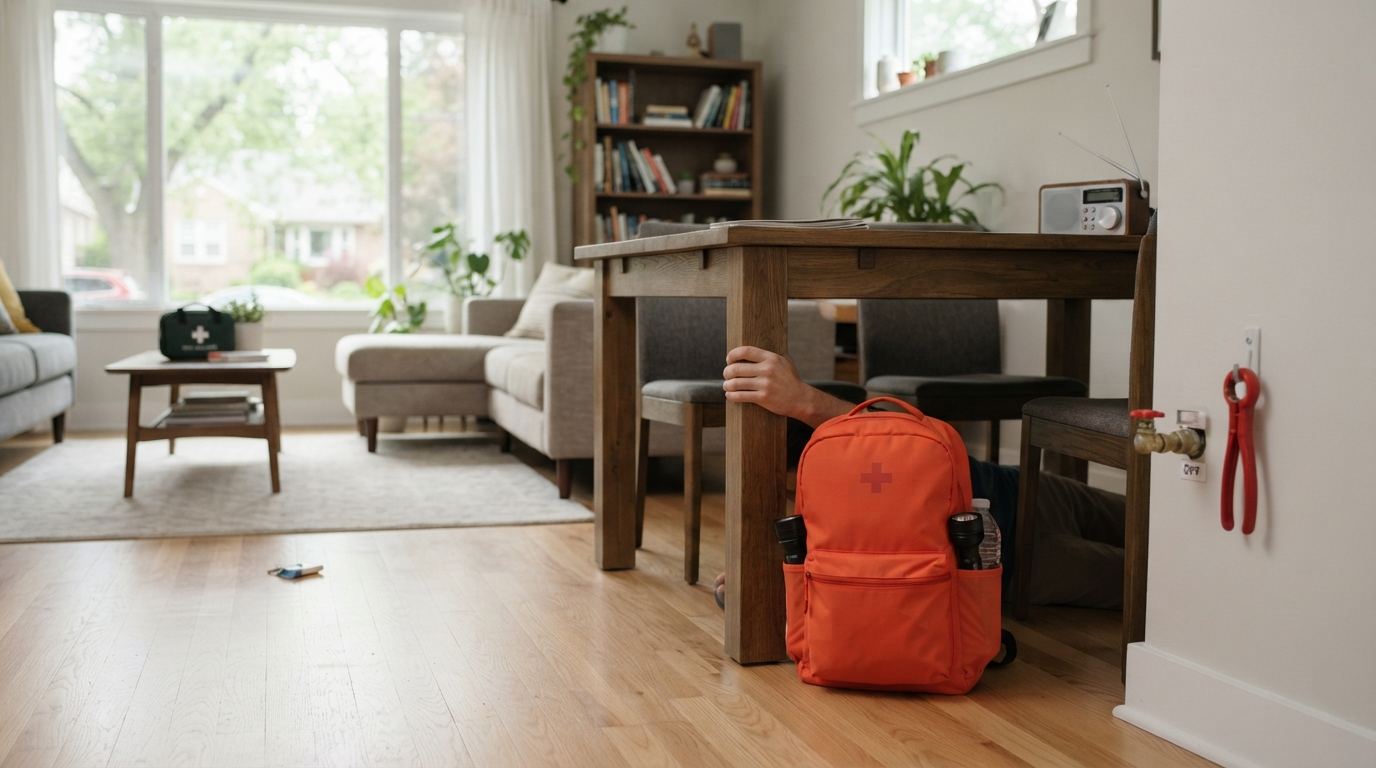
Earthquake safety in 2026: what to do during the shake and right after. Drop, cover, and hold on, handle aftershocks, shut off gas, and treat injuries.
This article contains affiliate links. If you buy through these links, we may earn a small commission at no extra cost to you.
Earthquakes give little warning. When strong shaking starts, drop to your hands and knees, cover your head and neck under the closest sturdy table if one is nearby, and hold on until the shaking stops. If you are indoors, stay there during the shaking. Outside, move away from buildings and wires. While driving, pull over clear of bridges and overpasses and stay in the car.
No one can predict the date or time of a major earthquake. A practiced response is more useful than a prediction. See preparing your home before the quake for the work you can do ahead of time.
Earthquake Safety During the Shake: Drop, Cover, and Hold On
The most important earthquake safety move: drop, cover, and hold on.
- DROP to your hands and knees before the shaking knocks you down. It keeps you below falling hazards.
- COVER your head and neck with one arm and crawl under a sturdy table or desk if one is within a few steps. No table? Get against an inside wall, away from windows.
- HOLD ON to your shelter with one hand. The ground moves sideways, not just up and down.
A few things that get people hurt:
- Do NOT run outside. Most injuries come from falling debris and toppled facades.
- Do NOT stand in a doorway. The old advice is wrong; modern doorways are not stronger.
- Ignore the "triangle of life." It is a debunked theory.
Do and Don't During an Earthquake
| Do | Don't |
|---|---|
| Drop to your hands and knees immediately | Don't run outside or stand in a doorway |
| Get under a sturdy table and cover your head | Don't use elevators or stairs during the shake |
| Hold on to your shelter until it stops | Don't light matches or candles (gas leaks are common) |
| Stay away from windows and tall furniture | Don't move seriously injured people unless they're in danger |
What to Do If You're Outside, Driving, or in Bed
If you're outside: move to an open area away from buildings, streetlights, and overhead wires. Drop and cover your head until the shaking stops. Stay at least as far away as the building is tall.
If you're driving: pull over, set the parking brake, and stay in the vehicle. Avoid overpasses and bridges. A Midland ER310 Emergency Radio pulls NOAA alerts when your phone has no signal. If power lines fall on your car, stay inside.
If you're in bed: stay there. Cover your head and neck with a pillow. Keep sturdy shoes beside the bed because broken glass can make the floor dangerous after the shaking.
If you're near the coast: a strong quake can trigger a tsunami within minutes. Drop, cover, and hold on, then move to high ground on foot; don't wait for an official warning. When to go, how far inland, and when it's safe to come back: see the tsunami warning guide.
During Aftershocks: Expect Them, and Treat Each One Seriously
Aftershocks can damage structures already weakened by the main quake.
- Use the same drill. Every aftershock gets the full drop, cover, hold on.
- Stay out of damaged buildings. A structure that survived the main quake can still fail during an aftershock.
- Keep information flowing. A Midland ER310 Emergency Radio can carry local emergency instructions when power or cell service is unavailable. USGS posts aftershock forecasts on earthquake event pages when it has enough data; do not expect a NOAA SAME alert for each aftershock. West Coast readers can also get a few seconds of warning before shaking arrives, see earthquake early warning (ShakeAlert) for where it works and what it can realistically buy you.
The First 10 Minutes After the Shaking Stops
1. Check yourself and the people around you. Attend to any bleeding first.
2. Put on sturdy shoes. Broken glass will cover floors and streets.
3. Check for gas leaks. If you smell gas (rotten-egg odor) or hear a hiss, shut off the main valve outside with a quarter-turn wrench. Don't light matches. Only shut it off if you smell or hear a leak; an unnecessary shutdown can take utilities days to restore.
4. Look for fire hazards. If you smell smoke, shut off the main breaker (only if you can safely) and use a fire extinguisher. A UL-rated 1-A:10-B:C unit like the Kidde FA110G Home Fire Extinguisher (1-A:10-B:C) belongs near your exit.
5. Listen for local emergency instructions. Cell service can fail after a major earthquake. Keep a battery radio on and use official local and USGS channels when service is available.
Treating Injuries and Bleeding With What You Have
Broken glass can cause serious injuries, and medical help may be delayed.
- Call 911 for life-threatening bleeding. Press clean gauze or cloth firmly and continuously on the wound. If blood soaks through, add more material on top without lifting the first dressing.
- Use a tourniquet for uncontrolled limb bleeding. If life-threatening bleeding from an arm or leg does not stop with direct pressure, apply a manufactured tourniquet if one is available and follow its instructions. Do not loosen it while waiting for help.
- Know what's in your kit. The First Aid Only 298-Piece All-Purpose Kit covers minor cuts, burns, and sprains for $17.91 at the checked buy box. The Surviveware Large First Aid Kit has labeled compartments that are easier to search in the dark. For trauma supplies, the MyMedic MyFAK Pro First Aid Kit includes a tourniquet, chest seals, and hemostatic gauze.
What to Grab After the Shaking Stops
After you've accounted for injuries and checked the gas, make one pass for your essentials, then get outside.
- Go-bag basics: meds, glasses, phone, wallet, keys
- Water and food (food and water storage guide)
- Power: a EcoFlow RIVER 3 Portable Power Station keeps phones and radios charged for days
- Warm layers and sturdy shoes even in summer
- Your emergency radio: Midland ER310 Emergency Radio
Grab what's within arm's reach and move to your safe meeting spot.
When Is It Safe to Re-enter?
People get hurt after the danger seems over.
- Don't re-enter a damaged building until local officials or a qualified inspector say it is safe. Aftershocks can bring down weakened walls, chimneys, and ceilings.
- Watch for: wall cracks, leaning structures, stuck doors, broken chimneys, fallen ceilings.
- Use stairs, never the elevator. Power can fail mid-ride.
- If you evacuated, wait for the official all-clear before going back.
What If You're Trapped?
Save your voice and make a repeatable signal rescuers can locate.
- Conserve air and energy. Lie still and breathe slowly.
- Tap before shouting. Knock three times, pause, then repeat on pipes or walls.
- Use a whistle. The Fox 40 Sonik Blast CMG Whistle stays loud when wet or dusty.
- Cover your mouth with cloth if dust is thick; don't light matches.
- Text instead of calling when the network is congested.
Quick Recommendations
- Budget home first-aid: First Aid Only 298-Piece All-Purpose Kit
- Best all-around family kit: Surviveware Large First Aid Kit
- Trauma-ready: MyMedic MyFAK Pro First Aid Kit
- Power for multi-day outages: EcoFlow RIVER 3 Portable Power Station
- Local instructions after an outage: Midland ER310 Emergency Radio
If the quake triggers a federal disaster declaration, FEMA's Individuals and Households Program can help with temporary housing and repair grants; the walkthrough is in our FEMA disaster assistance guide.
Frequently asked questions
What should I do during an earthquake?
Drop, cover, and hold on: get under a sturdy table, cover your head and neck, and hold on until shaking stops, about 10 to 60 seconds in most quakes. Do not run outside during shaking; falling facade debris injures people at doorways and exits.
What should I do after an earthquake hits?
Check people first, then gas leaks (smell of rotten eggs, shut the valve if you see the wheel-style shutoff and smell gas), then expect aftershocks. Do not re-enter badly damaged buildings. Text instead of calling; texts get through congested networks.
What do I do if I'm in bed during an earthquake?
Stay in bed, hold on, and cover your head with a pillow. You are less likely to be injured staying put than running past falling objects in the dark.