
Chase Bank Outage: What to Do When Banking Goes Down
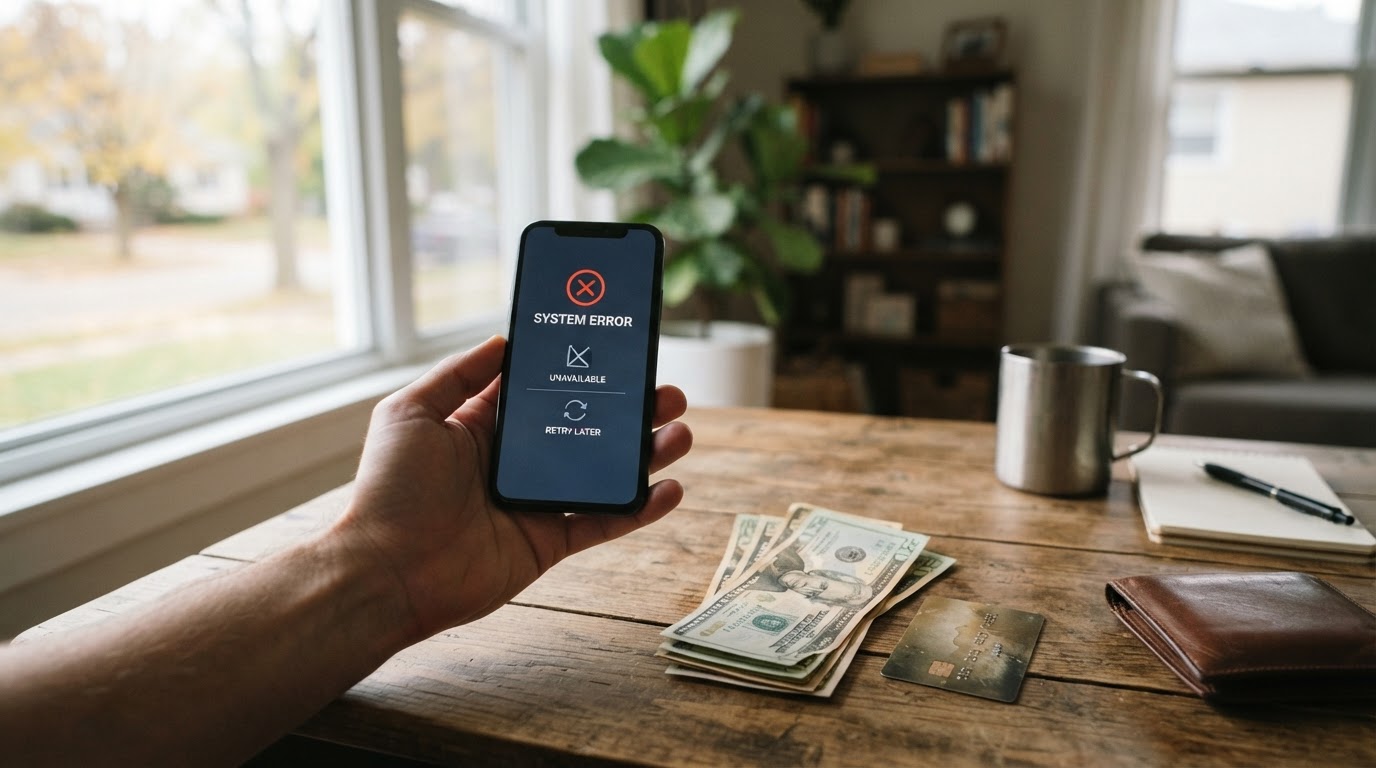
On Nov 16 a Chase software bug slowed payments nationwide. What to do when your banking app fails, plus the cash buffer that makes the next one a nuisance.
This article contains affiliate links. If you buy through these links, we may earn a small commission at no extra cost to you.
On Monday morning, November 16, Chase customers started seeing a short message in the app: some services were not available, try back later. What followed was a day of slow and stuck transactions at the country's largest bank, with delays spilling onto customers of other banks whenever Chase sat on the other side of the payment. By Monday evening Chase said operations were back to normal. The cause was not a hack and not an attack. In the bank's words, it was a software bug in its own on-premise hardware systems.
The scale is worth stating plainly. The Associated Press reported thousands of customers having trouble reaching online accounts, and outage tracker Downdetector logged nearly 4,800 Chase problem reports by 2 p.m. ET, plus spikes for Bank of America, Wells Fargo, U.S. Bank, Capital One, and Zelle. But those other banks said their own systems were fine. Bank of America told CBS News its systems had been operating normally all day; U.S. Bank said it was not directly impacted; Capital One said the same. The delays hit transactions where Chase was a party. Zelle's operator, Early Warning Services, said the Zelle network itself was running as it should, so late Zelle payments were delayed by the bank-side problem, not lost in transit. Per CBS News, Chase expected the fix by end of day, and the Washington Post confirmed operations were back to normal Monday evening.
This was also the third national technology failure in five days. Microsoft's Outlook and Teams went down the previous Thursday and came back Saturday. On Friday the FAA halted every departure in the country for more than four hours (we covered what stranded travelers learned). On Monday, while the banks wobbled, United Airlines also dealt with an internal system outage that delayed departures before it was resolved that evening. Notre Dame technology expert Mike Chapple told CBS the three incidents share a theme: the everyday systems we depend on are complex and fragile, and a technical problem in one place ripples through everything connected to it.
For preparedness, that ripple is the whole lesson. Money you cannot move is money you do not have, for exactly as long as the outage lasts.
When the app fails: work the other rails
A banking outage is rarely total. Different channels run on different systems, so the fix in the moment is to switch rails instead of retrying the same dead one.
Try the ATM, a branch, a different card, or phone banking before you assume you have no access. These often keep working when the app does not, and Chase branches were processing most transactions through Monday's glitch. If you bank only through one app on one phone, you have a single point of failure wearing a friendly icon.
Do not hammer the same transfer. Mashing retry on a stuck payment is how you send it twice once the queue clears. Make the attempt once, screenshot the confirmation or the failure with the amount and time visible, and keep a short log of what you tried. If a bill is due that day, call the payee before the deadline and tell them the payment is attempted but delayed. A record of the attempt beats an apology after a late fee.
Treat late Zelle payments as late, not lost. The network operator said its system was fine, which means the money was held up at one of the two banks, not swallowed. Give it the day before you try to reverse or resend anything.
The fix that makes the next outage boring
Outages end. The buffer that carries you through them is built on ordinary weekends, and it is mostly the emergency fund we keep recommending.
Keep some cash at home in small bills. Enough for a few days of fuel, food, and small purchases, often $100 to $500, in twenties and smaller. A store running without its normal register may not break a hundred, and Monday's outage was exactly the kind of day when a card reader or transfer you counted on quietly stops. Store it where fire and forgetfulness cannot get it: a SentrySafe 1210 Fireproof Box (about $37) handles the fire side. Our emergency fund guide sizes the full three-tier buffer this cash stash sits inside.
Keep a second way to pay that does not depend on your main bank. The emergency fund guide recommends holding part of the buffer at a different institution so one bank's outage or frozen account cannot block everything. Monday proved the point in both directions: Chase customers with an account elsewhere kept spending, and non-Chase customers learned their bank can still feel a Chase outage through shared payments.
Keep your records where an outage cannot lock them out. Account numbers, policy numbers, and contact numbers belong on paper in a grab-and-go binder, not only inside the app that is down. A DocSafe Fireproof Document Bag (about $19) keeps that binder organized and adds heat and splash resistance at home.
Then make the boring systems automatic. Our everyday financial resilience guide covers the buffer account, the bill calendar, and the automation that stops one bad week from cascading into four. A bill paid automatically days early never meets an outage at all.
Ready.gov's financial preparedness page makes the same point from the official side: document, save, and insure before the event, because every federal program that helps after one moves slower than your own buffer.
Three national systems failed in five days, and all three recovered within days. Nobody involved needed a bunker. They needed a second way to pay, a record of what they tried, and enough cash to cover the gap. Build those three things and the next outage is an annoyance you read about, not a problem you stand in line for.