
Trapped in Your Car During a Wildfire: What to Do (2026)
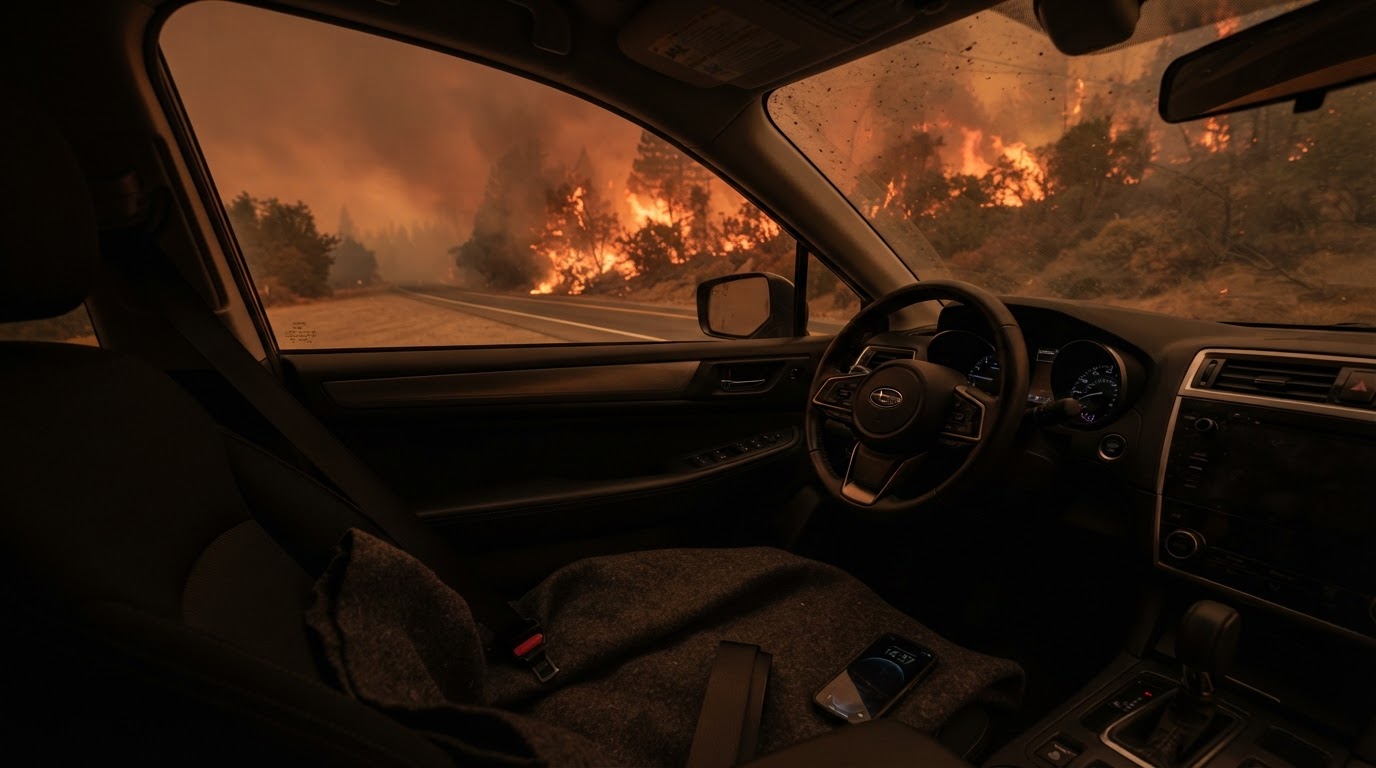
Trapped in your car during a wildfire? Park clear of vegetation, stay below the window line, cover with wool, and call 911. The survival steps for 2026.
This article contains affiliate links. If you buy through these links, we may earn a small commission at no extra cost to you.
If a wildfire cuts off your road and you cannot drive to safety, call 911 and shelter in the vehicle. Park in the most open spot you can reach, close the windows and vents, shut off the climate fan, get below the window line, and cover yourself with a wool blanket or jacket. A car is a last-resort shelter, but it usually blocks radiant heat better than open ground. Stay inside through the flame front unless the vehicle catches fire or responders direct you to a clearly safer shelter.
This is the failure case of the wildfire evacuation checklist: the order arrived, traffic stopped, or smoke closed the road ahead.
Trapped in your car during a wildfire: the five steps
- Park in the most open spot you can reach. A bare pull-off, wide shoulder, parking lot, or recently burned area is better than a road lined with brush and trees. Keep away from tall dry grass and overhanging branches.
- Close every window and vent, then shut off the climate fan. Outside smoke will still seep in, but closing the cabin limits how quickly it enters.
- Get below the window line. On the floor, seat reclined, head down. Glass may break and radiant heat pours through the windows; the lower body of the car is the coolest place in it.
- Cover yourself with a wool blanket or heavy jacket. Use wool or another natural-fiber layer; synthetic throws can melt. Do not rely on a wet cloth or bandana to filter smoke. It does not stop fine particles or toxic gases. Keep your face low, where the air is coolest.
- Call 911 and give your exact location. Mile marker, road name, cross streets, landmarks. Turn on the hazard lights and headlights so fire crews can see the car through smoke. Keep the call short.
Stay inside unless the vehicle catches fire, responders direct you elsewhere, or a clearly safer shelter is immediately reachable before the flame front arrives. Do not run into open brush.
Why the car helps, and where it fails
The car's value is radiant heat. The metal body and glass block the direct heat of the flame front, which is the main way fire injures people at a distance. On open ground that same heat hits you directly, which is why FEMA and state fire agencies point people to the vehicle's floor rather than a field or ditch.
The failure modes are real: upholstery and plastic trim ignite, tires burn, and windows can shatter from temperature swings. A car is not a rated fire shelter. Think of it as an improvised shield with a time limit. Stay low, stay covered, and the moment the front passes, reassess: if the cabin is smoking or the interior is igniting, get out and move to burned-over ground, which has no fuel left to burn.
Where you stop matters before the fire arrives too: no tall dry grass under the car, no overhanging branches that can drop burning needles.
When to leave the car instead
Two situations end the stay-put rule:
- The car catches fire or the interior fills with smoke from burning upholstery. Leave now and move to the nearest already-burned or barren ground.
- Responders direct you to move, or a substantial building is immediately reachable before flames or dense smoke arrive. Follow their route. Do not leave the vehicle for open brush.
If you must leave because the car is burning, follow responder directions if you can get them. Move to the nearest clearly burned or barren area and avoid brush, trees, and uphill routes with unburned fuel. Do not try to outrun the fire.
The fire-season car kit
None of this requires special gear, but four items make the steps above work better. Keep them in the car all fire season, not in a go bag at home.
- Cover: The Arcturus Military Wool Blanket (80% Wool, 66" x 90") is about $25 and rated 4.4 stars. Its 80% wool fabric will not melt like many synthetic throws. Use it as a covering inside the vehicle, not as a fire shelter.
- Escape: The RESQME Original Emergency Keychain Car Escape Tool is about $11 and rated 4.6 stars. Its punch works on tempered side glass, not laminated glass, and its blade can cut a jammed seatbelt. Check the window etching before fire season and keep the tool within reach.
- Comms: The Midland ER310 Emergency Radio is about $80 and rated 4.6 stars. Its 72-plus-hour battery and SOS beacon work when cell towers are congested or down, exactly when a fire is moving through.
- Smoke: The 3M Aura N95 Particulate Respirator 9205+ is about $15 and rated 4.5 stars. It filters fine particles during evacuation and sheltering, but not gases like carbon monoxide, and it does not help in low oxygen. It is a smoke layer, not a breathing apparatus.
Add bottled water for drinking. Do not rely on a damp cloth to filter smoke.
If you can still move: driving in smoke
The strongest move remains leaving early, and the wildfire smoke safety guide covers the air-quality side of that decision. If you are already in the car and smoke closes in: headlights on, hazards on, speed low, and stay on official evacuation routes. Never drive through flames, and never trust an unverified shortcut through brush. Stop for law enforcement and follow their directions. When cell service fails, the family emergency communication plan explains radio backup and out-of-area contacts.
Printable trapped-in-car wildfire checklist
- Windows and vents closed, air flow off
- Parked in the most open spot available, away from brush
- Everyone below the window line, heads down
- Wool blanket or heavy jacket over everyone
- Face kept low; no wet cloth or bandana relied on for smoke filtration
- 911 called with exact location (mile marker, road name)
- Hazards and headlights on so crews can see the car
- Car fire? Leave now, toward burned-over ground only
- Risk assessed after the front passes: stay only if the cabin is safe
Keep the blanket and escape tool where a passenger can reach them, not buried under luggage in the trunk.
Source notes: FEMA and Ready.gov wildland fire guidance, CAL FIRE Ready for Wildfire materials, and National Fire Protection Association wildfire safety guidance.
Frequently asked questions
What should I do if I am trapped in my car during a wildfire?
Pull over in the most open spot you can find, away from vegetation, close all windows and vents, get below the window line, cover yourself with a wool blanket or jacket, and call 911 with your exact location.
Should I get out of my car if a wildfire is near?
Usually, stay in the car if fire has cut off the road and no clearly safer shelter is close. A vehicle blocks radiant heat better than open ground. Follow responder instructions. Leave if the car catches fire, or if a substantial building is immediately reachable before flames or dense smoke arrive.
Can you survive a wildfire inside a car?
The car is a last-resort shelter, not a guarantee. Plastic trim, upholstery, and tires can ignite from radiant heat, so the goal is to stay below the window line and covered until the flame front passes, then leave the vehicle if it is unsafe.