
How to Walk on Ice Without Falling: 2026 Winter Safety Guide
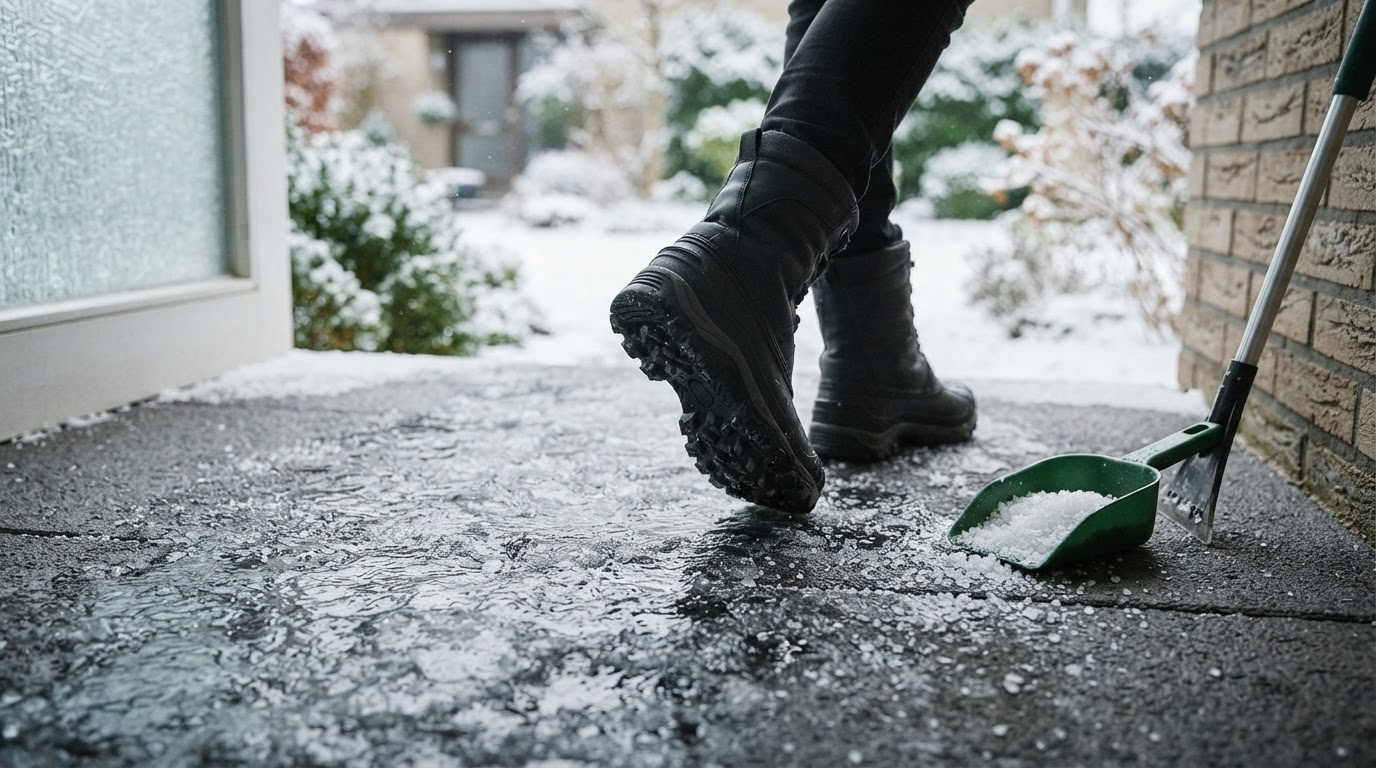
How to walk on ice without falling in 2026: the penguin shuffle, where black ice hides, de-icing your walkway, and what to do after a winter slip, step by step.
This article contains affiliate links. If you buy through these links, we may earn a small commission at no extra cost to you.
Walk like a penguin: short shuffle steps, flat feet, arms out of your pockets, weight over the front foot. A flat sole spreads your weight across the whole foot instead of a heel edge that slides.
Most winter falls happen close to home: the driveway, the front steps, the parking lot between the car and the door. Slips spike the first time the temperature hits freezing and again after every overnight refreeze, so ice safety has two parts: how you walk, and what you do to the surfaces you own.
The CDC lists falls as the leading cause of injury death among adults 65 and older. Technique matters more than expensive gear.
Keep these in your head:
- Shuffle, do not stride: short steps, flat feet, weight forward.
- Hands free and out of pockets. Pockets turn a slip into a fall.
- Look 3 to 4 feet ahead. Black ice is clear, not white.
- Treat your walk after shoveling and before the overnight freeze.
- If you fall, protect your head, take inventory, stand up slowly.
How to Walk on Ice: The Penguin Shuffle
Ice grips almost nothing, so the job is contact. A flat sole has more surface in play than a heel edge, and short steps keep your weight over the planted foot.
- Short steps. Half your normal stride, small and even.
- Flat feet. Land with the whole sole at once. No heel strike, no push-off.
- Weight forward, knees soft. Lean slightly ahead so your weight stays over the stable foot.
- Arms out. Hands out of pockets and free for balance. Carry groceries in a backpack when you can.
- Eyes 3 to 4 feet ahead. Read the surface before you commit your weight to it.
- Slow down. Use handrails on steps, one step at a time.
Where Black Ice Hides
Black ice is transparent. It looks like a wet patch or clean pavement, and it forms wherever meltwater refreezes.
- Shade. North-facing walks and anything the sun skips, which makes dawn the slickest walk of the day.
- Steps, thresholds, and downspouts, where drips land and freeze.
- The driveway apron and the strip along the garage, where roof melt runs.
- Smooth hard surfaces. Manhole covers, painted lines, and brick hold ice that open pavement does not.
Slush refreezes after sunset, so mornings are often the worst. Ice is also slickest near 32°F, when a film of water sits on top of it; deeper cold usually gives you more grip.
Gear That Helps (and What Does Not)
- Boots with soft rubber and deep tread. Hard, smooth soles slide like a puck. Check the heel, where tread disappears first.
- Slip-on traction cleats for a steep drive or an icy porch. The Yaktrax Walker Traction Cleats (1 Pair) is the pair we'd start with: about $22, and the steel coils bite packed snow and refrozen melt. Take them off at the door, where metal on tile is its own hazard.
- A light. You cannot dodge ice you cannot see, and winter commutes happen in the dark. A headlamp keeps both hands free for balance, which a phone flashlight does not. The Energizer PRO-400 Rechargeable Headlamp is about $16 and recharges over USB.
Hands in pockets and big strides are how most of us walk to the mailbox, and how we fall.
Clear and Treat the Walk
You cannot shuffle across every surface, so clear the ones you own. Shovel early, before foot traffic packs snow into ice, and again before the overnight freeze turns slush to glaze. Our snow shoveling guide covers technique and pace; this part is what you put down after.
| Treatment | Works to about | Keep in mind |
|---|---|---|
| Rock salt (sodium chloride) | 15°F | Cheapest. Harsh on paws, plants, and concrete. |
| Calcium chloride | -25°F | Faster, and rated for deep cold. Rougher on skin and plants. |
| Chloride-free ice melt | Near 0°F | Costs more. Follow the label around pets and surfaces. |
| Sand or kitty litter | Any temperature | Melts nothing. Grit for traction when nothing else works. |
The Safe Paw Pet-Safe Snow and Ice Melt (8 lb) is the chloride-free jug on our list: about $30 for 8 pounds, and the manufacturer rates it to -2°F. Spread it only as the label directs after clearing, then re-treat the steps before a refreeze. Sand is the other half: a coffee can by the door adds grip where ice melt cannot work fast enough.
If You Fall: Protect Your Head, Then Take Stock
A straight arm on the way down can break a wrist. If you feel the slip, tuck your chin toward your chest, land on your rear or thigh, and roll if you can.
Stay down and take inventory: did your head hit? Sharp pain? Can you get up? To rise, roll to your side, get on hands and knees, crawl to something stable (the car, a railing), and push up with both hands. Then get off the ice.
Check yourself again once the adrenaline fades. A cold pack can ease pain and swelling during the first hours, and … work from a car with no freezer; wrap one in cloth for 15 to 20 minutes.
Get urgent care after a head hit if there is confusion, vomiting, unusual drowsiness, worsening headache, loss of consciousness, or blood-thinner use. Seek care if you cannot bear weight, see a deformity, or swelling and pain are severe. If something might be broken, do not test it; our broken bone splint guide covers keeping it still. As a helper, do not pull someone up by the arm. Ask where it hurts, keep them still and warm, and call 911 for serious symptoms.
Winter Walking Checklist
- Winter boots with real tread by the door
- Walk cleared early, before it packs or refreezes
- Ice melt staged next to the shovel
- Sand or kitty litter for steps and the glare strip
- A light by the door for dark departures
- Phone in an inside pocket, not in your hand
- Cold packs in the car and the kitchen drawer
Quick Recommendations
- Free: the penguin shuffle. Practice it on the first cold morning, not the first fall.
- Treat the walk: Safe Paw chloride-free ice melt, about $30 per 8-pound jug.
- See and be seen: the Energizer PRO-400 headlamp, about $16 and hands-free.
- After a spill: MED PRIDE instant cold packs, about $10 for six.
- The home side of the same storm: the winter storm survival guide.
The shuffle looks silly for the two weeks the world turns to glare. Wrists and hips take months to heal.